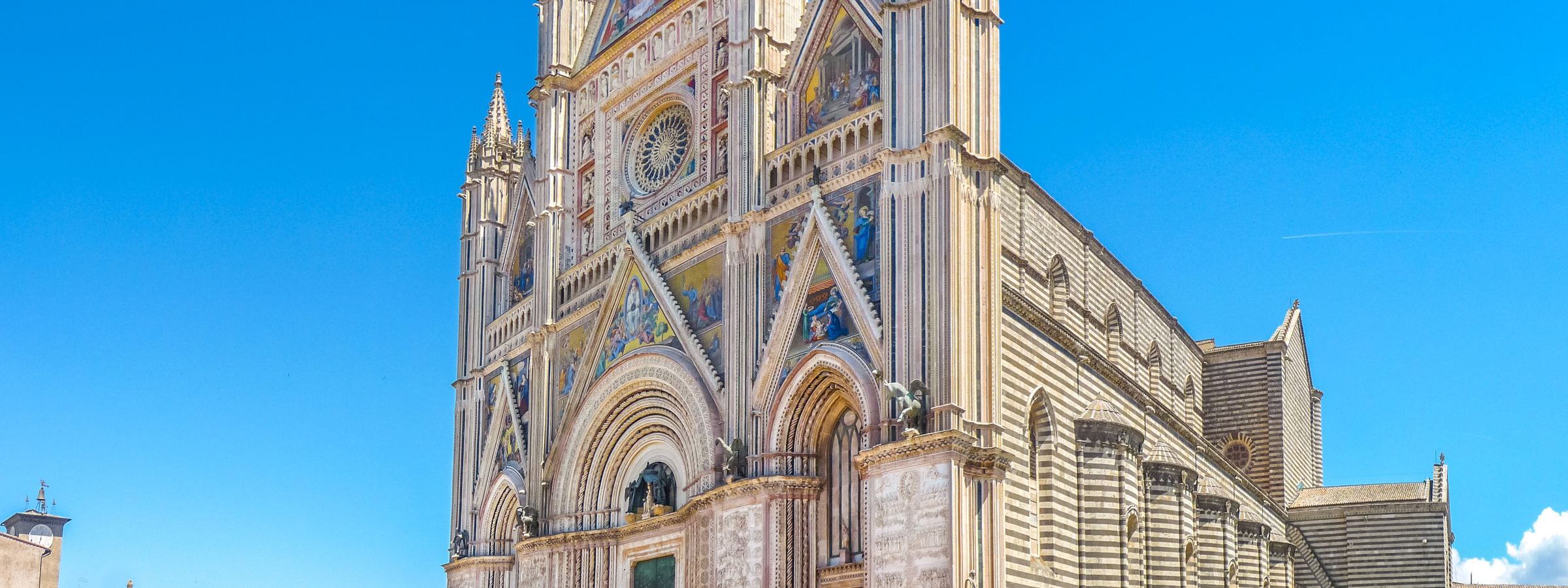
 Orvieto — Umbria · Italy →Photo: bluejayphoto / iStock
All destinations.
99 places carrying our editorial line — every one of them genuinely undertouristed, every one of them with a named editor and a real local voice.


Nový Bor
Two Bohemian glass towns still at work: furnaces you can stand over, Europe's oldest glass schools, and a basalt organ with no queue.

Třeboň
A town at the centre of a 500-year man-made pond landscape, where the autumn carp harvest is a working livelihood and the spa runs on local peat.


Aubusson
Six centuries of European tapestry-weaving in a small Creuse river town: a near-dead craft brought back to working life as UNESCO intangible heritage.
Saint-Junien
France's glove town: couture leather cut by hand beside the Vienne, a Romanesque collegiate church, Corot's riverbank — and very few other visitors.

The Aubrac
A high basalt plateau where Aubrac herds still walk up to summer pasture each May, past burons, aligot pots and the Le Puy Camino.


Metsovo
A Vlach town at 1,150 m in the Pindos: flocks still move with the seasons, Aromanian is spoken on the square, and the town dairy smokes its own PDO cheese.

Patra (Western Greece)
Greece's third city and its sea gateway to Italy, home to the largest carnival in the country.

Pannonhalma
Benedictines have kept the hours on this hill since 996 — basilica, school, winery and lavender rows run to the same bells, and day-trippers leave by dusk.

Őrség
Hungary's far-western "guard" country: dispersed hilltop hamlets, a living pottery tradition, pumpkin-seed oil, and a medieval church full of frescoes.

Aliano
The village on the edge of the lunar calanchi where Carlo Levi served his exile, and where he chose to be buried.
Sappada / Plodn
A German-speaking Dolomite village of fifteen hamlets, where the Piave river is born and the Carnival masks have been carved from the same wood for centuries.

Tratturo Magno
Italy's greatest droving road: 244 km of grass highway from L'Aquila to Foggia, anchored at Castel del Monte, shepherd capital of the Gran Sasso.

Trieste, through its writers
The Habsburg-Adriatic city of Joyce, Svevo and Saba, best read in October and November, when the Bora blows and the cafés half-empty.


Kashubia (Kaszuby)
A living language island in the Pomeranian lake hills, where Kashubian is Poland's only recognised regional language and the lakes are called Switzerland.

Suwalszczyzna
Poland's wild north-east: the deepest lake in Central Europe, a glacial landscape park and the lost Yotvingian borderland, reached by Rail Baltica.


Horezu
The Oltenian market town where the rooster plate is still thrown, horned and painted in family yards — with Brâncoveanu's finest monastery 3 km away.

Maramureș
Romania's living peasant north: UNESCO wooden churches, carved gates, the painted Merry Cemetery, and a forestry steam train up the Vaser valley.

Banská Štiavnica
A UNESCO silver-mining town in a collapsed volcano, with Europe's old mining university, a Baroque Calvary on the hill and a ring of man-made lakes.

Špania Dolina
A copper-mining village of 240 people above Banská Bystrica, where the miners' wives made bobbin lace — and the lace is still taught.