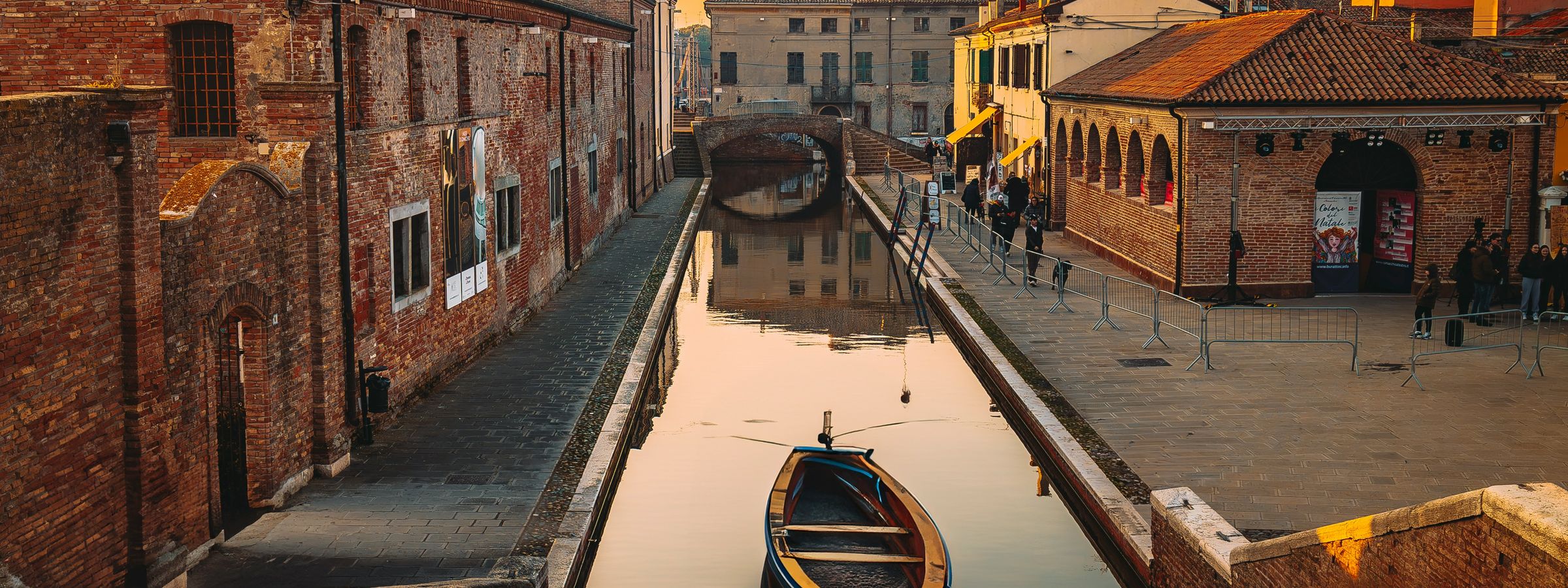
 Comacchio — Ferrara · Emilia-Romagna · Italy →Photo: Gabriele Merlino / Unsplash
All destinations.
104 places carrying our editorial line — every one of them genuinely undertouristed, every one of them with a named editor and a real local voice.


Lonjsko Polje
Croatia's great Sava floodplain, where storks crown the timber Posavina houses and herds graze wet commons in one of Europe's last living wetlands.

Sveti Martin na Muri
The Croatian village on the Mura, at the seam of three countries: wine hills above and a mineral spring below, with the Mura-Drava regional park as backyard.

Đurđevac
A Podravina market town where a medieval rooster legend, a lake of sand dunes, and the roots of Croatian naïve art meet. The crowds never arrive.

Mikulov and the Pálava
The Moravian wine capital on the Austrian border: Renaissance square, Jewish cemetery, the Pálava limestone hills, and twelve official vineyard tracts.

Nový Bor
Two Bohemian glass towns still at work: furnaces you can stand over, Europe's oldest glass schools, and a basalt organ with no queue.

Telč
A complete Renaissance market square reflected in three ponds, at its best after the day-trip coaches leave and the arcades fall quiet.

Třeboň
A town at the centre of a 500-year man-made pond landscape, where the autumn carp harvest is a working livelihood and the spa runs on local peat.

Valašsko (Moravian Wallachia)
The Moravian highlands where a century-old open-air museum and Jurkovič's timber chalets keep the shepherd past in plain sight.


Aubusson
Six centuries of European tapestry-weaving in a small Creuse river town: a near-dead craft brought back to working life as UNESCO intangible heritage.

Florac and the Cévennes
Capital village of the Cévennes National Park. Stevenson and his donkey came through in 1878, and the chestnut forests are still here.
Saint-Junien
France's glove town: couture leather cut by hand beside the Vienne, a Romanesque collegiate church, Corot's riverbank — and very few other visitors.

The Aubrac
A high basalt plateau where Aubrac herds still walk up to summer pasture each May, past burons, aligot pots and the Le Puy Camino.

Vallée de la Roya
A mountain valley behind the French Riviera, climbing from olive groves to Bronze Age rock art, its spine a single railway spiralling through the Alps to Italy.

Vercors
A vast limestone plateau in the pre-Alps with no railway, great caves, AOP blue cheese, and one of the heaviest Resistance memory-landscapes in France.


Delphi and the Phocis Hinterland
The navel of the world draws the coaches. Sleep here, wake early, then disappear into the olive groves and up the Parnassus ridge the coaches never reach.

Grevena
A Pindus capital famous across Greece for wild mushrooms, with Vlach pastoral villages and Ottoman-era stone bridges over the mountain rivers.
Marathon
The plain where the Persians lost in 490 BCE, and a modern coastal town an hour from Athens that has simply stayed itself.

Metsovo
A Vlach town at 1,150 m in the Pindos: flocks still move with the seasons, Aromanian is spoken on the square, and the town dairy smokes its own PDO cheese.

Patra (Western Greece)
Greece's third city and its sea gateway to Italy, home to the largest carnival in the country.

Trikala
Gateway to Meteora, birthplace of Asclepius, Greece's first "smart city": all three at once, on the rail line through Thessaly.

Pannonhalma
Benedictines have kept the hours on this hill since 996 — basilica, school, winery and lavender rows run to the same bells, and day-trippers leave by dusk.

Őrség
Hungary's far-western "guard" country: dispersed hilltop hamlets, a living pottery tradition, pumpkin-seed oil, and a medieval church full of frescoes.

Burren Food Trail
A network of farmhouse cheesemakers, smokehouses, oyster beds and chef-led kitchens mapped across the grey limestone karst of north County Clare.

Carlingford & Cooley Peninsula
A medieval walled port on the border-water of Carlingford Lough: Norman castle, Old Norse name, and a peninsula of mountain track behind it.

Cavan
The Lakeland County: 365 lakes scattered through drumlin country, with the source of the Shannon hidden on a mountain along the Northern Ireland border.

Clonakilty
A West Cork market town built on black pudding, Michael Collins's birthplace, and a pub that drew Ireland's best traditional players for forty years.

Great Western Greenway
Ireland's longest off-road greenway: 42 km along Clew Bay from Westport to Achill, on the trackbed of the Achill railway that closed in 1937.

Loop Head
A 30-kilometre Atlantic peninsula at the mouth of the Shannon: a working lighthouse at its tip, and the western anchor of the Wild Atlantic Way.

Scattery Island
A small Shannon Estuary island with a sixth-century monastic settlement, an Irish round tower, a Napoleonic battery and no permanent residents since 1978.

Sheep's Head
A walking peninsula in West Cork: 88 km of waymarked old farm tracks between Bantry Bay and Dunmanus Bay, one farmhouse cheese, three villages.

Aliano
The village on the edge of the lunar calanchi where Carlo Levi served his exile, and where he chose to be buried.

Arezzo
A working goldsmiths' city on the Florence–Rome line, holding a Piero della Francesca masterpiece: Renaissance Tuscany at a fraction of Florence's crowds.

Carnia
The upper Friulian Alps, where the Tagliamento rises among forestry villages that speak their own language and run their own dairy.

Castelmezzano
A village glued to the Lucanian Dolomites, where the main road runs out and the path begins.

Cividale del Friuli
Where Julius Caesar's marketplace became Italy's first Lombard duchy: a UNESCO town on an emerald river at the Slovene border.

Comacchio
A canal town in the Po Delta lagoons: bridges, eels, flamingos, and a Slow Food marinating works that keeps a centuries-old eel tradition alive.

Corinaldo
A near-complete circuit of medieval brick walls above the Verdicchio hills — one of central Italy's best-preserved borghi, overlooked for the coast.
Garfagnana
The green valley between the Apuan Alps and the Apennines, threaded by the slow Lucca–Aulla railway.
Genoa
Italy's vertical port city: one of Europe's largest medieval old towns, still working, still underrated.

Gressoney and the Walser Lys Valley
The upper Lys Valley, where a medieval German-speaking people settled under Monte Rosa and still speak their own alpine tongue.
Lunigiana
Tuscany before the postcards: castle-studded valleys between the Apennines and the sea, on the Parma–La Spezia rail line.
Luserna / Lusérn
A plateau village of 263 people above the Astico valley, where Cimbrian, a medieval Bavarian dialect, is still the everyday language of the street.
Maniago
Italy's knife town since the 1400s: water-powered forges, a museum in an old cutlery factory, workshops still grinding steel — and a railway back to life.

Modena
A UNESCO Romanesque heart and the world capital of true balsamic. Read Modena slowly, as a city of patient craft rather than racetrack speed.

Monte Isola
The largest lake island in Italy, rising from the quiet waters of Lake Iseo: car-free and ferry-reached, still fishing.

Norcia & Monti Sibillini
Saint Benedict's hometown under the Sibillini ridge, rebuilding since the 2016 earthquake; the Castelluccio lentils still flower every July.

Orvieto
A flat-topped town of volcanic tufa on the Rome–Florence main line. Most visitors leave by mid-afternoon; stay a night and Orvieto becomes yours.

Parma
A graceful former ducal capital and UNESCO City of Gastronomy: a producer visit by day, the Teatro Regio by night.

Penisola del Sinis – Mal di Ventre
Quiet western Sardinia: a quartz-beached peninsula, one of Europe's largest lagoons, Phoenician Tharros, and the Giants of Mont'e Prama.

Pietrapertosa
The highest village in Basilicata, split by a Saracen alley and a Norman castle, twin to Castelmezzano on the opposite cliff.

Potenza
The highest regional capital in Italy: a vertical Apennine city of escalators and lifts, with Musmeci's concrete bridge on the valley floor.

Ravenna
Eight UNESCO mosaic monuments, Dante's tomb, and a direct train line: the Carinthian Door trunk route ends here, at the western edge of the Po delta.

Salento (interior)
The deep heel of Italy, where a Greek-derived language still lives in a cluster of whitewashed villages and the whole coast empties after August.
Sanremo
Liberty-era villas and the climbing lanes of La Pigna, a few stops into Italy on the Riviera line.
Sappada / Plodn
A German-speaking Dolomite village of fifteen hamlets, where the Piave river is born and the Carnival masks have been carved from the same wood for centuries.
Specchia
Pale-stone alleys and walled gardens on a south-Salento hill, far enough inland that the coastal August never quite arrives.

Spoleto
An ancient hill town below a papal fortress, joined by a soaring medieval bridge to a sacred wood: one of Umbria's quietest "name" towns outside festival weeks.

Tratturo Magno
Italy's greatest droving road: 244 km of grass highway from L'Aquila to Foggia, anchored at Castel del Monte, shepherd capital of the Gran Sasso.

Trieste, through its writers
The Habsburg-Adriatic city of Joyce, Svevo and Saba, best read in October and November, when the Bora blows and the cafés half-empty.
Valle dei Mòcheni (Bersntol)
A side valley east of Trento where a Bavarian-derived language has been spoken since the thirteenth century, and three villages still use it every day.

Verona
A busy UNESCO city read the slow way: the quiet Veronetta left bank, spring and autumn timing, a day in the Valpolicella wine hills.


Beskid Niski (Low Beskids)
The emptiest range in the Polish Carpathians: Lemko ghost villages and UNESCO wooden churches in the absence that 1947 left behind.

Bieszczady
Poland's emptiest mountains, where the połoniny grasslands open above old-growth forest and ghost orchards mark villages erased in 1947.

Kashubia (Kaszuby)
A living language island in the Pomeranian lake hills, where Kashubian is Poland's only recognised regional language and the lakes are called Switzerland.

Suwalszczyzna
Poland's wild north-east: the deepest lake in the Central European lowlands, a glacial landscape park and the lost Yotvingian borderland, reached by Rail Baltica.

Aldeias do Xisto
Twenty-eight mountain villages in central Portugal, rebuilt from their own stone and linked by footpaths. Cerdeira is the place to start.

Faial Natural Park
A mid-Atlantic island shaped by a 1957 volcano and a transatlantic sailing harbour, with hydrangea hedges that turn the interior blue every July.

Miranda do Douro
The Portuguese border city where Mirandese is spoken: a 7,000-person Asturleonese language island on the cliffs above the Douro.

Mértola
A fortified spur where the Guadiana meets the Oeiras: Portugal's richest window onto Al-Andalus, with the country's only surviving medieval mosque.

São Brás de Alportel
Ten kilometres above the Algarve's busiest beaches, a plain working town that once corked half the world's wine — and still smells faintly of boiled bark.

Horezu
The Oltenian market town where the rooster plate is still thrown, horned and painted in family yards — with Brâncoveanu's finest monastery 3 km away.

Maramureș
Romania's living peasant north: UNESCO wooden churches, carved gates, the painted Merry Cemetery, and a forestry steam train up the Vaser valley.
Oradea
A border city of ninety Art Nouveau palaces standing on natural hot springs — restored, bilingual, and still barely on the international map.

The Painted Monasteries of Bucovina
Fifteenth-century churches painted inside and out — Voroneț blue, Last Judgements on exterior walls — still served by nuns in Romania's far northeast.

Banská Štiavnica
A UNESCO silver-mining town in a collapsed volcano, with Europe's old mining university, a Baroque Calvary on the hill and a ring of man-made lakes.

Špania Dolina
A copper-mining village of 240 people above Banská Bystrica, where the miners' wives made bobbin lace — and the lace is still taught.

Brda (Goriška Brda)
Vine-terraced hills draped over the Slovenian-Italian border, where the Rebula grape has been a habit and an argument since the thirteenth century.

Idrija
Five centuries of mercury and four of lace. When the mine closed in 1995, the town learned how to live on without pretending it never happened.

Kolpa (Bela Krajina)
Slovenia's clear-water river border with Croatia: swimming and kayak descents through birch-forest country in the country's forgotten southern corner.

Koper
Slovenia's Venetian port city: a bilingual, lived-in old town twenty kilometres from Trieste, still running at its own pace.

Kranj
Slovenia's Prešeren town: a compact medieval promontory above two river canyons, open to visitors by train on the Ljubljana–Villach corridor.

Laško
The Slovenian beer-and-thermal-water town: Heineken's largest Slovenian brewery, a 35°C mineral spring, the Pivo Cvetje festival every July.

Podčetrtek
On the Slovenian-Croatian border: one of the country's biggest thermal spas, a medieval castle reopened in 2024, a Pauline monastery pharmacy from 1675.

Solčavsko
Three glacial valleys under the Kamnik-Savinja Alps, where a handful of high farms keep the Savinja company from its source at the Rinka falls.

Soča Valley
A turquoise river running south from Triglav, villages that remember a different war, and no fast road in from anywhere.

A Guarda
A working lobster port at the mouth of the Miño, with an Iron-Age Celtic hillfort above and Portugal visible across the water.

Ebro Delta
The largest western Mediterranean wetland: 320 km² of Catalan rice fields, salt pans and the world's biggest Audouin's gull colony.

Ecoparque de Trasmiera (Arnuero)
The Cantabrian coastal park of a 2,100-person municipality: three villages, two beaches, a tidal mill, and the regeneration story the EDEN award recognised.

Goierri (Idiazabal Territory)
Basque highlands where raw-milk Idiazabal ripens in farmhouse caves and a market unchanged since 1512 still opens every Wednesday beneath the Txindoki peak.

Sierra de las Nieves
A national park of ancient fir forests and white Andalusian villages, rising from the back of Marbella into mountains most Costa del Sol visitors never see.
Sierra y Cañones de Guara
Spain's pre-Pyrenean canyon country: stone villages above limestone gorges and painted rock shelters beside the rivers where European canyoning began.
Tierra Ignaciana
Ignatius's birthplace and the starting line of the 650 km Camino Ignaciano, in the Basque hills around the Jesuit-Baroque Sanctuary of Loyola.
Valle del Ambroz
A valley below the Sierra de Béjar where a medieval Jewish quarter, Roman thermal baths and chestnut forests draw visitors with no interest in a crowd.